Research Article | | Peer-Reviewed

Electronic Health Record Adoption Among Health Information Management and ICT Staff in Tertiary Hospitals in North-East Nigeria: Level and Associated Factors

Received: 2 October 2026     Accepted: 12 October 2026     Published: 21 October 2026
Views:       Downloads:
Abstract

Background: Electronic health records (EHRs) underpin clinical documentation, disease classification and health reporting, but little is known about their adoption in tertiary hospitals in North-East Nigeria or about the views of the staff who manage them. This study assessed the level of EHR adoption among health information management (HIM) officers and information and communication technology (ICT) personnel and identified factors associated with high adoption. Methods: A cross-sectional survey was conducted in three tertiary teaching hospitals in Yola, Bauchi and Maiduguri. Staff were selected by proportionate stratified sampling (target 486, Cochran’s formula). A structured questionnaire measured adoption with 15 five-point items in five domains (availability, functional maturity, compatibility with the International Classification of Diseases, 11th Revision (ICD-11), interoperability, user proficiency); a score above 70% of the maximum was classed as high adoption. Data were analysed with chi-square tests and binary logistic regression in SPSS version 27. Results: Of 486 questionnaires, 475 were analysed (response rate 97.7%): 373 from HIM officers and 102 from ICT personnel. The mean adoption score was 3.77 (standard deviation [SD] 0.84) out of 5, and 74.9% (95% confidence interval [CI] 70.9-78.6) were high adopters (HIM 74.0%, ICT 78.4%, p = 0.359). ICD-11 compatibility was the lowest-scoring domain in both groups. High adoption was reported by 90.6% of respondents in Yola, 67.1% in Bauchi and 73.4% in Maiduguri (p < 0.001). After adjustment, high adoption was less likely in Bauchi (adjusted odds ratio [AOR] 0.18; 95% CI 0.08-0.38) and Maiduguri (AOR 0.23; 0.11-0.48) than in Yola, and more likely among middle-status respondents (AOR 3.19; 1.49-6.81) and those with 11 or more years of experience (AOR 2.94 and 3.01); odds fell with age (AOR 0.96 per year; 0.93-0.99). Professional group was not associated with adoption. Conclusion: Reported EHR adoption is high among HIM and ICT staff but differs markedly between hospitals, and readiness for ICD-11 is the weakest dimension. Hospital-specific support and ICD-11-oriented system configuration should be prioritised; the findings reflect staff perceptions and need confirmation by system audits.

Published in Biomedical Statistics and Informatics (Volume 11, Issue 4)
DOI 10.11648/j.bsi.20261104.11
Page(s) 86-98
Creative Commons

This is an Open Access article, distributed under the terms of the Creative Commons Attribution 4.0 International License (http://creativecommons.org/licenses/by/4.0/), which permits unrestricted use, distribution and reproduction in any medium or format, provided the original work is properly cited.

Copyright

Copyright © The Author(s), 2026. Published by Science Publishing Group

Keywords

Electronic Health Records, Adoption, Health Information Management, ICT Personnel, Tertiary Hospitals, Nigeria

1. Introduction
Digital technologies have become central to how health systems collect, store and use information. Electronic health records (EHRs) are among the most consequential of these tools. They replace paper charts with structured digital records that can be searched, shared and analysed, and they provide the platform on which clinical documentation, diagnostic classification and routine health reporting increasingly depend . A systematic review and meta-analysis of 47 studies found that EHR use reduced documentation time and medication errors and improved adherence to clinical guidelines, and a review of five Nigerian studies reported better data quality after electronic medical records were introduced . Digital health technologies are also regarded as an enabler of universal health coverage in Africa .
The pace of adoption has differed widely between regions, and policy has been a major driver. In the United States, federal incentives for the “meaningful use” of EHRs were followed by large gains in hospital EHR adoption . Many low- and middle-income countries have had neither comparable incentives nor the supporting infrastructure. In sub-Saharan Africa, EHR adoption has lagged, and unreliable electricity and internet connectivity, high costs, limited technical skills and weak governance are repeatedly named as barriers . A systematic review of physicians’ perspectives in developing economies found that computer literacy, education and user-friendly systems facilitated adoption, whereas lack of training, limited information technology (IT) experience, cost, time pressure and age-related resistance obstructed it . Earlier syntheses grouped the barriers into financial, technical, time, psychological, social, legal, organisational and change-process categories .
Nigeria illustrates both the promise and the difficulty. Digital health activity has grown, yet national assessments describe a sector held back by workforce gaps, weak infrastructure and fragmented governance . Studies in individual institutions show the same pattern. At a teaching hospital in Ondo State, financial constraints, insufficient information and communication technology (ICT) resources and unstable power supply were the main barriers, and only 1.3% of respondents reported significant EHR use . A survey of 1,177 health workers in four states found that perceived usefulness was the strongest predictor of electronic medical record adoption, and that perceived data risk reduced it . In Jos, about 71.5% of 228 frontline health workers had good knowledge of electronic medical records . Together, these studies suggest that readiness exists among health workers but that implementation is uneven and constrained by the environment.
Within hospitals, two professional groups sit at the centre of EHR use. Health information management (HIM) officers capture, code, store and retrieve patient information and are the main day-to-day users of records systems. ICT personnel deploy, configure and maintain those systems. Their assessment of how far EHRs have been adopted is therefore of direct operational importance. In Nigeria, however, the HIM workforce has faced gaps in information technology competence. A nationwide survey found that although 98.8% of HIM professionals valued information technology, only 8.1% worked in computerised environments, and later reviews pointed to training shortfalls, a shortage of qualified practitioners and the deployment of unqualified staff in records roles .
Factors that influence EHR adoption operate at the level of the individual, the organisation and the wider system. Technology acceptance research identifies perceived usefulness and ease of use as central to individual acceptance, and the information systems success model adds system quality, information quality and service quality . In health care, organisational factors such as training, IT support and management commitment feature prominently. In Kenya, training, ease of use and IT support facilitated electronic medical record use, while power blackouts, too few computers and delayed IT support obstructed it . In Tanzania, organisational readiness, including training and workflow integration, was the strongest determinant of consistent EHR use, and in Ghana, training raised the odds of satisfaction with an EHR about five-fold . Individual characteristics also matter. In Ethiopia, electronic medical record use was associated with fewer years of experience, a positive attitude, the availability of a manual and discussion of the system in meetings, whereas in Lesotho computer skills and educational qualification influenced perceived ease of use . Diffusion, readiness-for-change and sustainability frameworks add that technology alone is seldom sufficient .
A further reason to examine EHR adoption now is the transition to the International Classification of Diseases, 11th Revision (ICD-11). The World Health Assembly adopted ICD-11 in 2019, and it came into effect on 1 January 2022 . ICD-11 was designed for use in electronic environments and contains substantially more precoordinated codes than the 10th revision (ICD-10) . Using it in routine practice therefore depends on an EHR whose code set, search function and data-exchange standards have been configured for it. For this reason, we measured not only general availability and functionality but also ICD-11 compatibility as a distinct dimension of EHR adoption.
Despite this, we found little evidence on EHR adoption from the perspective of HIM and ICT staff in Nigerian tertiary hospitals. Most Nigerian studies have surveyed clinicians or been confined to a single institution , and we did not find a Nigerian study that treated ICD-11 compatibility as part of EHR adoption. The North-East geopolitical zone is particularly under-studied. It comprises Adamawa, Bauchi, Borno, Gombe, Taraba and Yobe States and has been affected by insurgency for more than a decade. A World Health Organization assessment in Borno State found that of 743 health facilities, 35% were completely destroyed and 29% partially damaged . Routine health data from the zone are also of variable quality; in Gombe State, for example, data on maternal and newborn indicators in the national District Health Information Software 2 (DHIS2) platform were incomplete at least 40% of the time .
The tertiary teaching hospitals in Yola, Bauchi and Maiduguri are the main referral institutions in the zone, and their experience of digitisation is a useful indicator of what is achievable in a fragile setting. This study therefore assessed the level of EHR adoption among HIM officers and ICT personnel in three tertiary hospitals in North-East Nigeria, compared the two professional groups, and identified the socio-demographic and institutional factors associated with high adoption. The findings are intended to inform hospital managers, State Ministries of Health and national digital health planners on where investment is most needed.
2. Materials and Methods
2.1. Study Area
The study was conducted in Adamawa, Bauchi and Borno States, in the North-East geopolitical zone of Nigeria. One federal tertiary teaching hospital in each state took part. Modibbo Adama University Teaching Hospital (MAUTH), Yola, was formerly the Federal Medical Centre, Yola, and was upgraded to a university teaching hospital in 2022 . Abubakar Tafawa Balewa University Teaching Hospital (ATBUTH), Bauchi, began as a leprosarium in 1918, became a federal teaching hospital after the 2010 federal takeover, has more than 700 beds, and receives referrals from Bauchi and from Plateau, Gombe, Taraba, Yobe, Jigawa, Borno, Kano and Adamawa States . University of Maiduguri Teaching Hospital (UMTH), Maiduguri, was commissioned in 1983, has about 1,577 beds, and reports serving the six North-East states and parts of neighbouring countries . Adamawa and Borno States have been affected by armed conflict, and the Borno health system in particular is recovering from large-scale destruction of facilities .
2.2. Study Design, Population, and Data Source
A descriptive and analytical cross-sectional survey design was used. The report follows the Strengthening the Reporting of Observational Studies in Epidemiology (STROBE) recommendations for cross-sectional studies . The study population comprised 753 HIM professionals and ICT staff working in the three hospitals: 163 at MAUTH (124 HIM, 39 ICT), 279 at ATBUTH (226 HIM, 53 ICT) and 311 at UMTH (243 HIM, 68 ICT), a total of 593 HIM and 160 ICT staff. These groups were chosen because they are directly responsible for patient data management, diagnostic coding and EHR support. The data source was primary data collected for this study.
2.3. Eligibility Criteria
Eligible participants were permanently employed HIM officers or ICT staff directly involved in patient data management, disease coding or EHR support, who had at least one year of continuous service in their current facility, had working knowledge of health information systems, and gave written informed consent. Senior administrators, policymakers and auditors, students, interns and temporary trainees, staff working across several facilities or on external postings, staff on prolonged leave, staff directly responsible for evaluating or enforcing ICD-11 or EHR policies, and individuals who declined or withdrew consent were excluded.
2.4. Sample Size Determination
The sample size was calculated with Cochran’s finite-population formula :
n = Z2p(1− p)N / [e2(N − 1) + Z2p(1− p)]
where N = 753 (study population), Z = 1.96 (95% confidence level), p = 0.5 (maximum variability) and e = 0.03 (margin of error). The numerator is 1.962 × 0.25 × 753 = 723.18 and the denominator is 0.032 × 752 + 0.9604 = 1.6372, giving n = 441.7, rounded to 442. After adding 10% for non-response (442 × 1.10), the target sample was 486.
2.5. Sampling Technique
A multi-stage approach was used. First, three of the six states in the zone (Adamawa, Bauchi and Borno) were included, and one tertiary hospital was purposively selected in each, on the basis of an existing EHR system and engagement with ICD-related processes. Second, the 486 questionnaires were allocated to hospitals in proportion to the number of staff in each (n = 486 × hospital staff / 753), giving 107 for MAUTH, 180 for ATBUTH and 199 for UMTH. Third, within each hospital the allocation was divided between HIM and ICT staff in proportion to their numbers (MAUTH 81 HIM and 26 ICT; ATBUTH 146 and 34; UMTH 156 and 43; total 383 HIM and 103 ICT). Finally, simple random sampling was used to select individual respondents from the eligible staff in each stratum.
2.6. Dependent and Independent Variables
The outcome variable was the level of EHR adoption (high or low). The independent variables were age (in years), gender, highest educational qualification (secondary or higher), self-reported socio-economic status (low, middle or high), years of professional experience (1-5, 6-10, 11-15 or 16 or more), hospital (MAUTH, ATBUTH or UMTH) and professional group (HIM or ICT).
2.7. Data Collection Instrument and Procedure
Data were collected with a structured, self-administered questionnaire, with one version for HIM officers and one for ICT personnel. Section A recorded socio-demographic characteristics. Section B measured EHR adoption with 15 statements in five domains of three statements each: availability of EHR systems, functional maturity of the EHR system, ICD-11 compatibility of the EHR system, interoperability, and user proficiency. The ICT version was worded from a technical perspective (for example, “ICD-11 code libraries are integrated into the EHR system”), so the two versions are parallel but not identical. Each statement was rated on a five-point scale from 1 (strongly disagree) to 5 (strongly agree). Item scores were summed (range 15-75), expressed as a percentage of the maximum, and classified as high adoption when above 70% and low adoption when below 70%. Domain and overall mean scores were interpreted using five equal-width bands (1.00-1.80, 1.81-2.60, 2.61-3.40, 3.41-4.20 and 4.21-5.00), the band 3.41-4.20 being interpreted as high. The researcher administered the questionnaires in person at each, with repeated follow-up visits to improve return.
2.8. Validity and Reliability of Instrument
Items were developed from the literature on EHR adoption and ICD-11 implementation and reviewed by academic supervisors for face and content validity. The questionnaire was pilot-tested in a comparable tertiary hospital outside the study sample, and the pilot data were used to assess clarity and internal consistency. Cronbach’s alpha was calculated for each section, with a value of 0.70 or higher taken as acceptable .
2.9. Data Analysis
Data were coded and analysed with SPSS version 27. Frequencies, percentages, means and standard deviations (SD) described the respondents and the adoption scores, and exact 95% confidence intervals (CI; Wilson method) were calculated for proportions. Associations between respondent characteristics and adoption level were tested with the chi-square test, or Fisher’s exact test where expected counts were below five . Binary logistic regression was used to identify factors associated with high adoption. Crude odds ratios (OR) for categorical variables were calculated against the first category as reference, and the adjusted model included all the characteristics listed in Section 2.6 simultaneously. The less frequent outcome (low adoption, n = 119) gave 10.8 events per model parameter, above the minimum of 10 usually recommended . Results are reported as adjusted odds ratios (AOR) with 95% confidence intervals, and p < 0.05 (two-sided) was considered statistically significant.
2.10. Ethical Approval
Ethical approval was obtained from the Research Ethics Committee of Rivers State University (RSU/FBMS/REC/25/429) and from the ethics boards of the participating hospitals (MAUTHY/HREC/26/433, ATBUTH/REC/26/019, and UMTH/REC/26/021). Eligible staff received an information sheet describing the purpose, procedures, risks and benefits of the study and gave written informed consent. Participation was voluntary, withdrawal was allowed at any stage without penalty, and responses were anonymised and stored in password-protected files accessible only to the research team.
3. Results
3.1. Response Rate and Characteristics of Respondents
Of 486 questionnaires distributed, 475 were correctly completed and returned, an overall response rate of 97.7%. This comprised 373 of 383 questionnaires for HIM officers (97.4%) and 102 of 103 for ICT personnel (99.0%). Respondents were 52.2% female, and the mean age was 35.9 years (SD 8.2). Nearly half (44.0%) were aged 31-40 years, 96.0% held a diploma or higher qualification, and 79.4% described themselves as middle socio-economic status. HIM officers were older (mean 36.9 versus 32.3 years) and more experienced, with 27.6% having served for 16 or more years compared with 4.9% of ICT personnel. By hospital, 22.3% of respondents were from MAUTH, 35.8% from ATBUTH and 41.9% from UMTH (Table 1).
Table 1. Socio-demographic characteristics of respondents.

Characteristic

HIM officers (n = 373)

ICT personnel (n = 102)

Total (N = 475)

Gender

Male

193 (51.7)

34 (33.3)

227 (47.8)

Female

180 (48.3)

68 (66.7)

248 (52.2)

Age (years)

≤30

97 (26.0)

60 (58.8)

157 (33.1)

31-40

177 (47.5)

32 (31.4)

209 (44.0)

41-50

78 (20.9)

6 (5.9)

84 (17.7)

≥51

21 (5.6)

4 (3.9)

25 (5.3)

Mean ± SD

36.88 ± 8.01

32.28 ± 7.65

35.89 ± 8.15

Highest educational qualification

Secondary

18 (4.8)

1 (1.0)

19 (4.0)

Higher (diploma/BSc/MSc/PhD)

355 (95.2)

101 (99.0)

456 (96.0)

Socio-economic status

Low

32 (8.6)

5 (4.9)

37 (7.8)

Middle

293 (78.6)

84 (82.4)

377 (79.4)

High

48 (12.9)

13 (12.7)

61 (12.8)

Years of experience

1-5

68 (18.2)

46 (45.1)

114 (24.0)

6-10

76 (20.4)

22 (21.6)

98 (20.6)

11-15

126 (33.8)

29 (28.4)

155 (32.6)

≥16

103 (27.6)

5 (4.9)

108 (22.7)

Hospital

MAUTH, Yola

80 (21.4)

26 (25.5)

106 (22.3)

ATBUTH, Bauchi

139 (37.3)

31 (30.4)

170 (35.8)

UMTH, Maiduguri

154 (41.3)

45 (44.1)

199 (41.9)

Values are n (%) unless stated. HIM, health information management; ICT, information and communication technology; MAUTH, Modibbo Adama University Teaching Hospital; ATBUTH, Abubakar Tafawa Balewa University Teaching Hospital; UMTH, University of Maiduguri Teaching Hospital.
3.2. Level of EHR Adoption
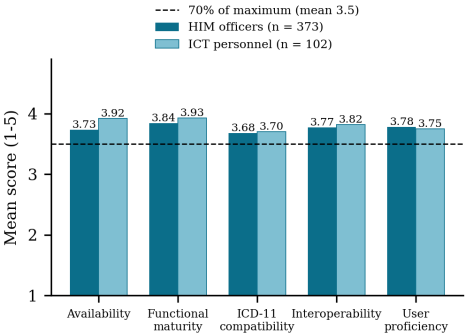
Table 2 shows the mean scores for the five adoption domains. Overall, HIM officers scored 3.76 (SD 0.87) and ICT personnel 3.82 (SD 0.69), and the combined mean was 3.77 (SD 0.84), all within the “high” band (3.41-4.20). Functional maturity of the EHR system had the highest mean in both groups (HIM 3.84; ICT 3.93). ICD-11 compatibility had the lowest domain mean in both groups (HIM 3.68; ICT 3.70), and interoperability and availability scored only slightly higher among HIM officers (3.77 and 3.73). Among HIM officers, the highest-rated statement was confidence in using the EHR system for health records management (mean 3.94, SD 1.24), and the lowest-rated statements were the ability of the EHR system to exchange patient information with other hospital systems (3.54, SD 1.36) and its support for ICD-11 coding standards (3.55, SD 1.25). For the former, 62.2% agreed or strongly agreed and 24.4% disagreed or strongly disagreed; for the latter, 63.2% agreed or strongly agreed and 22.0% disagreed or strongly disagreed. Among ICT personnel, the highest-rated statement was reliable system access for routine operations (3.98, SD 0.95) and the lowest was the integration of ICD-11 code libraries into the EHR system (3.59, SD 1.01); here 52.0% agreed or strongly agreed, 41.2% were neutral and 6.9% disagreed or strongly disagreed (Figure 1).
Table 2. Mean scores of EHR adoption domains and classification of adoption level.

Domain

HIM officers Mean (SD)

ICT personnel Mean (SD)

Availability of EHR systems

3.73 (1.02)

3.92 (0.82)

Functional maturity of the EHR system

3.84 (0.99)

3.93 (0.71)

ICD-11 compatibility of the EHR system

3.68 (1.07)

3.70 (0.73)

Interoperability

3.77 (1.04)

3.82 (0.82)

User proficiency with the EHR system

3.78 (0.96)

3.75 (0.86)

Overall mean score

3.76 (0.87)

3.82 (0.69)

High (above 70%)

276 (74.0)

80 (78.4)

Low (below 70%)

97 (26.0)

22 (21.6)

Combined overall mean score for all respondents (N = 475): 3.77 (SD 0.84); high adoption 356 (74.9%), low adoption 119 (25.1%). Scores were rated 1 (strongly disagree) to 5 (strongly agree). Mean scores of 3.41-4.20 are interpreted as high.
Figure 1. Mean scores of EHR adoption domains by professional group (scale 1-5).
Using the 70% cut-off, 356 of 475 respondents (74.9%; 95% CI 70.9-78.6) were classified as high adopters and 119 (25.1%) as low adopters. The proportion was 74.0% among HIM officers and 78.4% among ICT personnel, and the difference was not statistically significant (χ2 = 0.84, p = 0.359).
3.3. Factors Associated with EHR Adoption
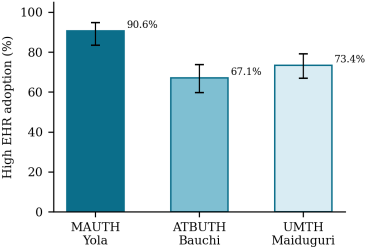
In bivariate analysis (Table 3), the proportion with high adoption differed significantly by socio-economic status (χ2 = 15.47, p < 0.001) and hospital (χ2 = 19.67, p < 0.001). High adoption was reported by 78.5% of middle-status respondents compared with 51.4% of those of low status and 67.2% of those of high status. By hospital, it was reported by 90.6% of respondents at MAUTH, 67.1% at ATBUTH and 73.4% at UMTH (Figure 2). Gender, age group, educational qualification, years of experience and professional group were not significantly associated with adoption.
Table 3. Association between respondent characteristics and level of EHR adoption.

Characteristic

n

High n (%)

Low n (%)

χ2

p-value

Gender

2.12

0.145

Male

227

177 (78.0)

50 (22.0)

Female

248

179 (72.2)

69 (27.8)

Age (years)

5.91

0.116

≤30

157

118 (75.2)

39 (24.8)

31-40

209

165 (78.9)

44 (21.1)

41-50

84

55 (65.5)

29 (34.5)

≥51

25

18 (72.0)

7 (28.0)

Educational qualification

0.428†

Secondary

19

16 (84.2)

3 (15.8)

Higher

456

340 (74.6)

116 (25.4)

Socio-economic status

15.47

<0.001

Low

37

19 (51.4)

18 (48.6)

Middle

377

296 (78.5)

81 (21.5)

High

61

41 (67.2)

20 (32.8)

Years of experience

5.65

0.130

1-5

114

78 (68.4)

36 (31.6)

6-10

98

70 (71.4)

28 (28.6)

11-15

155

123 (79.4)

32 (20.6)

≥16

108

85 (78.7)

23 (21.3)

Facility

19.67

<0.001

MAUTH, Yola

106

96 (90.6)

10 (9.4)

ATBUTH, Bauchi

170

114 (67.1)

56 (32.9)

UMTH, Maiduguri

199

146 (73.4)

53 (26.6)

Professional group

0.84

0.359

HIM officers

373

276 (74.0)

97 (26.0)

ICT personnel

102

80 (78.4)

22 (21.6)

Total

475

356 (74.9)

119 (25.1)

χ2, chi-square statistic; †Fisher’s exact test (expected count below 5), so no χ2 is shown. All tests have df = 1 except age (3), socio-economic status (2), years of experience (3) and hospital (2).
Figure 2. Proportion of respondents with high EHR adoption by hospital (bars show 95% confidence intervals).
Table 4 presents the logistic regression. After adjustment, six characteristics were independently associated with high adoption. Compared with MAUTH, respondents at ATBUTH (AOR 0.18; 95% CI 0.08-0.38) and UMTH (AOR 0.23; 95% CI 0.11-0.48) had lower odds of high adoption. Respondents of middle socio-economic status had higher odds than those of low status (AOR 3.19; 95% CI 1.49-6.81), whereas those of high status did not differ significantly (AOR 1.52; 95% CI 0.60-3.81). Compared with respondents with 1-5 years of experience, those with 11-15 years (AOR 2.94; 95% CI 1.50-5.76) and 16 or more years (AOR 3.01; 95% CI 1.37-6.62) had higher odds, while those with 6-10 years did not differ significantly (AOR 1.20; 95% CI 0.62-2.31). Each additional year of age was associated with 4% lower odds of high adoption (AOR 0.96; 95% CI 0.93-0.99). Gender, educational qualification and professional group were not significant. Several crude associations changed after adjustment: for example, the crude odds ratio for experience of 16 or more years was 1.71 (95% CI 0.93-3.13), and age was not associated with adoption in the unadjusted analysis (crude OR 0.99; 95% CI 0.96-1.01).
Table 4. Binary logistic regression of factors associated with high EHR adoption (N = 475).

Characteristic

Crude OR (95% CI)

p-value

Adjusted OR (95% CI)

p-value

Age (per year)

0.99 (0.96-1.01)

0.281

0.96 (0.93-0.99)

0.020

Gender (ref: Male)

Female

0.73 (0.48-1.11)

0.146

0.68 (0.43-1.08)

0.100

Educational qualification (ref: Secondary)

Higher

0.55 (0.16-1.92)

0.348

0.43 (0.11-1.63)

0.216

Socio-economic status (ref: Low)

Middle

3.46 (1.74-6.90)

<0.001

3.19 (1.49-6.81)

0.003

High

1.94 (0.84-4.49)

0.120

1.52 (0.60-3.81)

0.376

Years of experience (ref: 1-5)

6-10

1.15 (0.64-2.08)

0.634

1.20 (0.62-2.31)

0.587

11-15

1.77 (1.02-3.09)

0.043

2.94 (1.50-5.76)

0.002

≥16

1.71 (0.93-3.13)

0.085

3.01 (1.37-6.62)

0.006

Facility (ref: MAUTH, Yola)

ATBUTH, Bauchi

0.21 (0.10-0.44)

<0.001

0.18 (0.08-0.38)

<0.001

UMTH, Maiduguri

0.29 (0.14-0.59)

<0.001

0.23 (0.11-0.48)

<0.001

Professional group (ref: HIM officers)

ICT personnel

1.28 (0.76-2.16)

0.360

1.48 (0.81-2.70)

0.207

OR, odds ratio; CI, confidence interval; ref, reference category. Outcome: high EHR adoption (1) versus low (0). Adjusted odds ratios are from the model containing all characteristics. Crude odds ratios for categorical variables were recalculated against the reference category from the cell counts in Table 3; the crude odds ratio for age is from the univariable model.
4. Discussion
This study set out to measure how far EHRs have been adopted among the staff who use and maintain them in three tertiary hospitals in North-East Nigeria, and to identify the characteristics associated with adoption. Three findings stand out. First, three in four respondents (74.9%) reported high adoption, and HIM officers and ICT personnel did not differ. Second, readiness for ICD-11 was the weakest dimension of adoption in both groups, while functional maturity was the strongest. Third, the hospital in which a respondent worked was the strongest correlate of adoption, ahead of professional group, gender or education.
The level of adoption we found is higher than most published Nigerian and African estimates. At a teaching hospital in Ondo State, only 1.3% of respondents reported significant EHR use, and in Dire Dawa, Ethiopia, 26.6% of professionals used an electronic medical record . In a nationwide survey published in 2015, only 8.1% of Nigerian HIM professionals worked in computerised environments . Closer to our figure, 71.5% of health workers at Jos University Teaching Hospital had good knowledge of electronic medical records , although knowledge is not use. Several features of our study probably contribute to the difference. The hospitals were chosen because they already had EHR systems, our respondents were the specialists who work with records every day, and adoption was measured by perception and not by system audit. Our estimate should therefore be read as the level among staff in EHR-equipped tertiary hospitals, not as the level across the North-East zone. It would also be wrong to assume that the same pattern would be seen among clinicians, whose views often differ from those of records staff .
The domain scores show where the system is strong and where it is not. Functional maturity, meaning the ability to support documentation and clinical coding and to receive updates, scored highest, and respondents were confident in their own use of the system. Compatibility with ICD-11 scored lowest in both groups. Among HIM officers, the statements on ICD-11 coding standards and on exchanging information with other hospital systems had the lowest means, and among ICT personnel, who would know best, 41.2% were neutral about whether ICD-11 code libraries had been integrated and only 52.0% agreed. This pattern is what one would expect when systems were installed and configured around earlier classifications and have not yet been updated. ICD-11 was designed for electronic use and has a much larger set of precoordinated codes than ICD-10 , so a system that supports ICD-10 will not support ICD-11 automatically. Experience from the national pilot of ICD-11 morbidity coding in China, where coders reached 82.9% accuracy after a short training, shows that technical readiness and coder preparation can be addressed together . Our finding that ICD-11 compatibility lags behind general EHR maturity supports the view that a high level of EHR adoption does not by itself signal readiness for the new classification.
HIM officers and ICT personnel gave similar overall ratings, and the proportion with high adoption did not differ significantly between them. ICT personnel rated availability and functional maturity somewhat higher (3.92 and 3.93 versus 3.73 and 3.84), a difference we did not test formally. A plausible reason is that the staff who deploy the systems see the infrastructure that exists, whereas HIM officers experience the gaps in day-to-day use, for example when parts of the system are unavailable in their unit. This is consistent with the observation that 17.9% of HIM officers disagreed that an EHR system was available in their facility even though most agreed, which suggests that coverage is uneven within hospitals. The similarity of the two groups is encouraging because shared perceptions are a prerequisite for the joint planning that implementation requires .
The large difference between hospitals is the most important finding for planning. The proportion of high adopters was 90.6% at MAUTH but 67.1% at ATBUTH and 73.4% at UMTH, and after adjustment the odds at ATBUTH and UMTH were less than a quarter of those at MAUTH. Our data cannot say why. Organisational factors that the literature links to EHR use, such as training, IT support, reliable power and internet, management commitment and workflow integration, were not measured separately for each hospital . The hospitals also differ in age, size and history: MAUTH was upgraded to a teaching hospital as recently as 2022, which may have brought newer systems, while ATBUTH and UMTH are larger and older institutions . Readiness-for-change and sustainability frameworks suggest that adoption depends on shared commitment, resources and the complexity of what is being introduced , and the contrast between the hospitals fits that view. With only three hospitals, however, hospital effects cannot be separated from other unmeasured differences, and we regard the finding as a pointer to where to look, not as an explanation.
Among individual characteristics, experience and age behaved differently. Respondents with 11 or more years of experience had about three times the odds of reporting high adoption compared with those with 1-5 years, whereas each additional year of age was associated with slightly lower odds. Experience and age are strongly related, so the age coefficient describes the effect of age among staff of equal experience, and the two estimates should be read together. Taken together, they suggest that longer service, perhaps because experienced staff have seen the transition from paper and understand the systems, is associated with a favourable view, and that older staff of a given length of service are somewhat less positive. The second part agrees with the age-related resistance reported in a systematic review of electronic medical record (EMR) adoption in developing economies . The first part differs from the Ethiopian study, in which fewer years of experience were associated with use , but that study surveyed all professionals in public facilities and not records specialists. Educational qualification was not associated with adoption, but 96.0% of our respondents had a higher qualification, which leaves little room for variation, whereas in Lesotho education influenced perceived ease of use among a broader group of health workers . Professional group was not associated with adoption, so the high level of adoption cannot be attributed to one cadre.
Socio-economic status was associated with adoption in a pattern that is not easy to interpret: respondents of middle status were more likely to report high adoption than those of low status, but those of high status were not. Status was self-reported on a three-point scale, only 37 respondents described themselves as low status, and the pattern may reflect measurement error or a chance finding as much as a real gradient. We found no comparable result in the literature and recommend that this variable be interpreted cautiously.
These findings have implications for theory and practice. They support the argument from technology acceptance and information systems success models that user proficiency and system quality are necessary for adoption , but they also show that quality along general dimensions does not guarantee readiness for a specific new standard. For policy, the United States experience shows that incentives tied to defined functional requirements can raise adoption quickly . A similar approach in Nigeria could tie EHR funding to measurable progress in ICD-11 configuration and interoperability, in line with the World Health Organization (WHO) global strategy on digital health . At hospital level, the differences between facilities call for diagnostic assessments of power, connectivity, training and IT support before investment, and the lower scores of older staff call for training that takes account of their needs .
The study has several strengths. The response rate was high (97.7%), sampling was proportionate to the size of each hospital and professional group, the instrument covered ICD-11 compatibility alongside general EHR functions, and the adjusted analysis accounted for hospital, profession and individual characteristics. It also has limitations. First, the cross-sectional design cannot show the direction of associations. Second, adoption was measured by self-report, which is open to social desirability and common-method bias , and no system audit or direct observation was done. Third, the hospitals were chosen because they had EHR systems, so the results probably overstate adoption in the zone, and with only three hospitals the findings may not apply to secondary or primary facilities or to other zones. Fourth, the 70% threshold for high adoption is conventional and we did not examine other thresholds, although the mean scores in Table 2 are consistent with the classification. Fifth, some categories were small (19 respondents with secondary education and 37 of low socio-economic status), which limits precision, as the wide confidence intervals for those groups show. Finally, the insecurity in parts of the zone may have affected responses in ways we could not measure.
5. Conclusion and Recommendation
Three in four HIM officers and ICT staff in the three hospitals reported a high level of EHR adoption, and both groups gave similar answers. Adoption was strongest for how well the systems work (functional maturity) and weakest for how well they fit ICD-11. It also differed a lot between hospitals, and the hospital in Yola scored highest. Staff with longer experience, staff of middle socio-economic status, and younger staff of equal experience were more likely to report high adoption. In short, EHRs are well established in these hospitals, but they are not yet ready for ICD-11.
We recommend the following. (i) Hospital managements, working with their ICT units, should upgrade the current EHR systems to include ICD-11 code lists, search tools and standard ways of sharing data. (ii) Hospitals with lower adoption, especially ATBUTH and UMTH, should review their power supply, internet connection, training and IT support, and make a support plan for each hospital. (iii) Training should suit the needs of older and less experienced staff. (iv) The Federal Ministry of Health and State Ministries of Health should link EHR funding to progress on ICD-11 readiness and data sharing. (v) Future studies should follow staff over time, audit the systems, use interviews, include more hospitals and smaller facilities, and measure organisational factors directly.
Abbreviations

AOR

Adjusted Odds Ratio

ATBUTH

Abubakar Tafawa Balewa University Teaching Hospital

CI

Confidence Interval

EHR

Electronic Health Record

HIM

Health Information Management

ICD-11

International Classification of Diseases, 11th Revision

ICT

Information and Communication Technology

MAUTH

Modibbo Adama University Teaching Hospital

OR

Odds Ratio

SD

Standard Deviation

STROBE

Strengthening the Reporting of Observational Studies in Epidemiology

UMTH

University of Maiduguri Teaching Hospital

Acknowledgments
The authors thank the management and staff of Modibbo Adama University Teaching Hospital, Abubakar Tafawa Balewa University Teaching Hospital and University of Maiduguri Teaching Hospital for permission to conduct the study and for taking part.
Author Contributions
Minkailu Abubakar Amadu: Conceptualization, Data curation, Formal Analysis, Investigation, Methodology, Writing – original draft
Peter Uduak Augustine: Methodology, Supervision, Validation, Writing – review & editing
Queen Desmond Atuzie: Data curation, Formal Analysis, Validation, Writing – original draft
Priscillia Nyekpunwo Ogbonda: Data curation, Formal Analysis, Validation, Writing – review & editing
Boma Judith Fubara: Data curation, Investigation
Rose Ibifaka Blakk: Data curation, Investigation
Anthony Ike Wegbom: Conceptualization, Methodology, Supervision, Validation, Writing – review & editing
Conflicts of Interests
The authors declare no conflicts of interest.
References
[1] World Health Organization (WHO). Global strategy on digital health 2020-2025. Geneva: World Health Organization; 2021.
[2] Campanella, P., Lovato, E., Marone, C., Fallacara, L., Mancuso, A., Ricciardi, W., Specchia, M. L. The impact of electronic health records on healthcare quality: a systematic review and meta-analysis. European Journal of Public Health. 2016, 26(1), 60-64.
[3] Olukorode, S. O., Adedeji, O. J., Adetokun, A., Abioye, A. I. Impact of electronic medical records on healthcare delivery in Nigeria: a review. PLOS Digital Health. 2024, 3(9), e0000420.
[4] Olu, O., Muneene, D., Bataringaya, J. E., Nahimana, M. R., Ba, H., Turgeon, Y., et al. How can digital health technologies contribute to sustainable attainment of universal health coverage in Africa? A perspective. Frontiers in Public Health. 2019, 7, 341.
[5] Blumenthal, D., Tavenner, M. The “meaningful use” regulation for electronic health records. New England Journal of Medicine. 2010, 363(6), 501-504.
[6] Adler-Milstein, J., Jha, A. K. HITECH Act drove large gains in hospital electronic health record adoption. Health Affairs. 2017, 36(8), 1416-1422.
[7] Akanbi, M. O., Ocheke, A. N., Agaba, P. A., Daniyam, C. A., Agaba, E. I., Okeke, E. N., Ukoli, C. O. Use of electronic health records in sub-Saharan Africa: progress and challenges. Journal of Medicine in the Tropics. 2012, 14(1), 1-6.
[8] Odekunle, F. F., Odekunle, R. O., Shankar, S. Why sub-Saharan Africa lags in electronic health record adoption and possible strategies to increase its adoption in this region. International Journal of Health Sciences (Qassim). 2017, 11(4), 59-64.
[9] Kaboré, S. S., Ngangue, P., Soubeiga, D., Barro, A., Pilabré, A. H., Bationo, N., et al. Barriers and facilitators for the sustainability of digital health interventions in low and middle-income countries: a systematic review. Frontiers in Digital Health. 2022, 4, 1014375.
[10] Derecho, K. C., Cafino, R., Aquino-Cafino, S. L., Isla, A. Jr., Esencia, J. A., Lactuan, N. J., et al. Technology adoption of electronic medical records in developing economies: a systematic review on physicians' perspective. Digital Health. 2024, 10, 20552076231224605.
[11] Boonstra, A., Broekhuis, M. Barriers to the acceptance of electronic medical records by physicians from systematic review to taxonomy and interventions. BMC Health Services Research. 2010, 10, 231.
[12] Ajami, S., Bagheri-Tadi, T. Barriers for adopting electronic health records (EHRs) by physicians. Acta Informatica Medica. 2013, 21(2), 129-134.
[13] Ravi, N., Thomas, C., Odogwu, J. How to reload and upgrade digital health to serve the healthcare needs of Nigerians. Frontiers in Digital Health. 2023, 5, 1225092.
[14] Babatope, A. E., Adewumi, I. P., Ajisafe, D. O., Adepoju, K. O., Babatope, A. R. Assessing the factors militating against the effective implementation of electronic health records (EHR) in Nigeria. Scientific Reports. 2024, 14, 31398.
[15] Akwaowo, C. D., Sabi, H. M., Ekpenyong, N., Isiguzo, C. M., Andem, N. F., Maduka, O., et al. Adoption of electronic medical records in developing countries: a multi-state study of the Nigerian healthcare system. Frontiers in Digital Health. 2022, 4, 1017231.
[16] Afolaranmi, T. O., Hassan, Z. I., Dawar, B. L., Wilson, B. D., Zakari, A. I., Bello, K. K., et al. Knowledge of electronic medical records system among frontline health care workers in Jos University teaching hospital, Plateau State Nigeria. International Journal of Research in Medical Sciences. 2020, 8(11), 3837-3843.
[17] Adeleke, I. T., Lawal, A. H., Adio, R. A., Adebisi, A. A. Information technology skills and training needs of health information management professionals in Nigeria: a nationwide study. Health Information Management Journal. 2015, 44(1), 30-38.
[18] Makinde, O. A., Mami, M. I., Oweghoro, B. M., Oyediran, K. A., Mullen, S. Investing in health information management: the right people, in the right place, at the right time. Health Information Management Journal. 2016, 45(2), 90-96.
[19] Ojo, A. I. Repositioning health information management practice in Nigeria: suggestions for Africa. Health Information Management Journal. 2018, 47(3), 140-144.
[20] Adeleke, I. T., Suleiman-Abdul, Q. B., Aliyu, A., Ishaq, I. A., Adio, R. A. Deploying unqualified personnel in health records practice: role substitution or quackery? Implications for health services delivery in Nigeria. Health Information Management Journal. 2019, 48(3), 152-156.
[21] Davis, F. D. Perceived usefulness, perceived ease of use, and user acceptance of information technology. MIS Quarterly. 1989, 13(3), 319-340.
[22] Venkatesh, V., Morris, M. G., Davis, G. B., Davis, F. D. User acceptance of information technology: toward a unified view. MIS Quarterly. 2003, 27(3), 425-478.
[23] DeLone, W. H., McLean, E. R. Information systems success: the quest for the dependent variable. Information Systems Research. 1992, 3(1), 60-95.
[24] DeLone, W. H., McLean, E. R. The DeLone and McLean model of information systems success: a ten-year update. Journal of Management Information Systems. 2003, 19(4), 9-30.
[25] Ngugi, P. N., Were, M. C., Babic, A. Users' perception on factors contributing to electronic medical records systems use: a focus group discussion study in healthcare facilities setting in Kenya. BMC Medical Informatics and Decision Making. 2021, 21, 362.
[26] Mwogosi, A. Factors influencing electronic health record system use in public health facilities in Tanzania. Discover Public Health. 2025, 22, 681.
[27] Acheampong, E., Oppong, D. K., Agyei, G. K. Electronic health record system and service delivery: using cross-sectional survey to assess the perspective of healthcare professionals in a semi-rural district in the Ashanti region of Ghana. Digital Health. 2025, 11, 20552076251393400.
[28] Tolera, A., Oljira, L., Dingeta, T., Abera, A., Roba, H. S. Electronic medical record use and associated factors among healthcare professionals at public health facilities in Dire Dawa, eastern Ethiopia: a mixed-method study. Frontiers in Digital Health. 2022, 4, 935945.
[29] Sekoai, T. E., Turner, A., Mitchell, J. Insights into healthcare workers' perceptions of electronic medical record system utilization: a cross-sectional study in Mafeteng district, Lesotho. BMC Medical Informatics and Decision Making. 2025, 25, 181.
[30] Rogers, E. M. Diffusion of innovations. 5th ed. New York: Free Press; 2003.
[31] Weiner, B. J. A theory of organizational readiness for change. Implementation Science. 2009, 4, 67.
[32] Greenhalgh, T., Wherton, J., Papoutsi, C., Lynch, J., Hughes, G., A'Court, C., Hinder, S., Fahy, N., Procter, R., Shaw, S. Beyond adoption: a new framework for theorizing and evaluating nonadoption, abandonment, and challenges to the scale-up, spread, and sustainability of health and care technologies. Journal of Medical Internet Research. 2017, 19(11), e367.
[33] World Health Organization (WHO). International Classification of Diseases 11th Revision (ICD-11) [Internet]. Geneva: World Health Organization; 2019. Available from:
[34] Harrison, J. E., Weber, S., Jakob, R., Chute, C. G. ICD-11: an international classification of diseases for the twenty-first century. BMC Medical Informatics and Decision Making. 2021, 21(Suppl 6), 206.
[35] Fung, K. W., Xu, J., Bodenreider, O. The new International Classification of Diseases 11th edition: a comparative analysis with ICD-10 and ICD-10-CM. Journal of the American Medical Informatics Association. 2020, 27(5), 738-746.
[36] World Health Organization (WHO). Full impact of devastated health services in north-eastern Nigeria revealed by WHO report [Internet]. Geneva: World Health Organization; 2016 Dec 14. Available from:
[37] Bhattacharya, A. A., Umar, N., Audu, A., Felix, H., Allen, E., Schellenberg, J. R. M., Marchant, T. Quality of routine facility data for monitoring priority maternal and newborn indicators in DHIS2: a case study from Gombe State, Nigeria. PLOS ONE. 2019, 14(1), e0211265.
[38] Modibbo Adama University Teaching Hospital, Yola. About the hospital [Internet]. Available from:
[39] Vanguard. FG approves upgrade of FMC Yola to Modibbo Adama University Teaching Hospital [Internet]. Lagos: Vanguard Media; 2022 May. Available from:
[40] Abubakar Tafawa Balewa University Teaching Hospital, Bauchi. About us [Internet]. Available from:
[41] University of Maiduguri Teaching Hospital. About us [Internet]. Available from:
[42] von Elm, E., Altman, D. G., Egger, M., Pocock, S. J., Gøtzsche, P. C., Vandenbroucke, J. P. The Strengthening the Reporting of Observational Studies in Epidemiology (STROBE) statement: guidelines for reporting observational studies. The Lancet. 2007, 370(9596), 1453-1457.
[43] Cochran, W. G. Sampling techniques. 3rd ed. New York: John Wiley & Sons; 1977.
[44] Krejcie, R. V., Morgan, D. W. Determining sample size for research activities. Educational and Psychological Measurement. 1970, 30(3), 607-610.
[45] Tavakol, M., Dennick, R. Making sense of Cronbach's alpha. International Journal of Medical Education. 2011, 2, 53-55.
[46] Kim, H.-Y. Statistical notes for clinical researchers: chi-squared test and Fisher's exact test. Restorative Dentistry & Endodontics. 2017, 42(2), 152-155.
[47] Peduzzi, P., Concato, J., Kemper, E., Holford, T. R., Feinstein, A. R. A simulation study of the number of events per variable in logistic regression analysis. Journal of Clinical Epidemiology. 1996, 49(12), 1373-1379.
[48] Zhang, M., Wang, Y., Jakob, R., Su, S., Bai, X., Jing, X., et al. Methodologies and key considerations for implementing the International Classification of Diseases-11th revision morbidity coding: insights from a national pilot study in China. Journal of the American Medical Informatics Association. 2024, 31(5), 1084-1092.
[49] Akhlaq, A., McKinstry, B., Muhammad, K. B., Sheikh, A. Barriers and facilitators to health information exchange in low- and middle-income country settings: a systematic review. Health Policy and Planning. 2016, 31(9), 1310-1325.
[50] De Benedictis, A., Lettieri, E., Gastaldi, L., Masella, C., Urgu, A., Tartaglini, D. Electronic medical records implementation in hospital: an empirical investigation of individual and organizational determinants. PLOS ONE. 2020, 15(6), e0234108.
[51] Podsakoff, P. M., MacKenzie, S. B., Lee, J.-Y., Podsakoff, N. P. Common method biases in behavioral research: a critical review of the literature and recommended remedies. Journal of Applied Psychology. 2003, 88(5), 879-903.
Cite This Article
  • APA Style

    Amadu, M. A., Augustine, P. U., Atuzie, Q. D., Ogbonda, P. N., Fubara, B. J., et al. (2026). Electronic Health Record Adoption Among Health Information Management and ICT Staff in Tertiary Hospitals in North-East Nigeria: Level and Associated Factors. Biomedical Statistics and Informatics, 11(4), 86-98. https://doi.org/10.11648/j.bsi.20261104.11

    Copy | Download

    ACS Style

    Amadu, M. A.; Augustine, P. U.; Atuzie, Q. D.; Ogbonda, P. N.; Fubara, B. J., et al. Electronic Health Record Adoption Among Health Information Management and ICT Staff in Tertiary Hospitals in North-East Nigeria: Level and Associated Factors. Biomed. Stat. Inform. 2026, 11(4), 86-98. doi: 10.11648/j.bsi.20261104.11

    Copy | Download

    AMA Style

    Amadu MA, Augustine PU, Atuzie QD, Ogbonda PN, Fubara BJ, et al. Electronic Health Record Adoption Among Health Information Management and ICT Staff in Tertiary Hospitals in North-East Nigeria: Level and Associated Factors. Biomed Stat Inform. 2026;11(4):86-98. doi: 10.11648/j.bsi.20261104.11

    Copy | Download

  • @article{10.11648/j.bsi.20261104.11,
      author = {Minkailu Abubakar Amadu and Peter Uduak Augustine and Queen Desmond Atuzie and Priscillia Nyekpunwo Ogbonda and Boma Judith Fubara and Rose Ibifaka Blakk and Anthony Ike Wegbom},
      title = {Electronic Health Record Adoption Among Health Information Management and ICT Staff in Tertiary Hospitals in North-East Nigeria: Level and Associated Factors},
      journal = {Biomedical Statistics and Informatics},
      volume = {11},
      number = {4},
      pages = {86-98},
      doi = {10.11648/j.bsi.20261104.11},
      url = {https://doi.org/10.11648/j.bsi.20261104.11},
      eprint = {https://article.sciencepublishinggroup.com/pdf/10.11648.j.bsi.20261104.11},
      abstract = {Background: Electronic health records (EHRs) underpin clinical documentation, disease classification and health reporting, but little is known about their adoption in tertiary hospitals in North-East Nigeria or about the views of the staff who manage them. This study assessed the level of EHR adoption among health information management (HIM) officers and information and communication technology (ICT) personnel and identified factors associated with high adoption. Methods: A cross-sectional survey was conducted in three tertiary teaching hospitals in Yola, Bauchi and Maiduguri. Staff were selected by proportionate stratified sampling (target 486, Cochran’s formula). A structured questionnaire measured adoption with 15 five-point items in five domains (availability, functional maturity, compatibility with the International Classification of Diseases, 11th Revision (ICD-11), interoperability, user proficiency); a score above 70% of the maximum was classed as high adoption. Data were analysed with chi-square tests and binary logistic regression in SPSS version 27. Results: Of 486 questionnaires, 475 were analysed (response rate 97.7%): 373 from HIM officers and 102 from ICT personnel. The mean adoption score was 3.77 (standard deviation [SD] 0.84) out of 5, and 74.9% (95% confidence interval [CI] 70.9-78.6) were high adopters (HIM 74.0%, ICT 78.4%, p = 0.359). ICD-11 compatibility was the lowest-scoring domain in both groups. High adoption was reported by 90.6% of respondents in Yola, 67.1% in Bauchi and 73.4% in Maiduguri (p Conclusion: Reported EHR adoption is high among HIM and ICT staff but differs markedly between hospitals, and readiness for ICD-11 is the weakest dimension. Hospital-specific support and ICD-11-oriented system configuration should be prioritised; the findings reflect staff perceptions and need confirmation by system audits.},
     year = {2026}
    }
    

    Copy | Download

  • TY  - JOUR
    T1  - Electronic Health Record Adoption Among Health Information Management and ICT Staff in Tertiary Hospitals in North-East Nigeria: Level and Associated Factors
    AU  - Minkailu Abubakar Amadu
    AU  - Peter Uduak Augustine
    AU  - Queen Desmond Atuzie
    AU  - Priscillia Nyekpunwo Ogbonda
    AU  - Boma Judith Fubara
    AU  - Rose Ibifaka Blakk
    AU  - Anthony Ike Wegbom
    Y1  - 2026/10/21
    PY  - 2026
    N1  - https://doi.org/10.11648/j.bsi.20261104.11
    DO  - 10.11648/j.bsi.20261104.11
    T2  - Biomedical Statistics and Informatics
    JF  - Biomedical Statistics and Informatics
    JO  - Biomedical Statistics and Informatics
    SP  - 86
    EP  - 98
    PB  - Science Publishing Group
    SN  - 2578-8728
    UR  - https://doi.org/10.11648/j.bsi.20261104.11
    AB  - Background: Electronic health records (EHRs) underpin clinical documentation, disease classification and health reporting, but little is known about their adoption in tertiary hospitals in North-East Nigeria or about the views of the staff who manage them. This study assessed the level of EHR adoption among health information management (HIM) officers and information and communication technology (ICT) personnel and identified factors associated with high adoption. Methods: A cross-sectional survey was conducted in three tertiary teaching hospitals in Yola, Bauchi and Maiduguri. Staff were selected by proportionate stratified sampling (target 486, Cochran’s formula). A structured questionnaire measured adoption with 15 five-point items in five domains (availability, functional maturity, compatibility with the International Classification of Diseases, 11th Revision (ICD-11), interoperability, user proficiency); a score above 70% of the maximum was classed as high adoption. Data were analysed with chi-square tests and binary logistic regression in SPSS version 27. Results: Of 486 questionnaires, 475 were analysed (response rate 97.7%): 373 from HIM officers and 102 from ICT personnel. The mean adoption score was 3.77 (standard deviation [SD] 0.84) out of 5, and 74.9% (95% confidence interval [CI] 70.9-78.6) were high adopters (HIM 74.0%, ICT 78.4%, p = 0.359). ICD-11 compatibility was the lowest-scoring domain in both groups. High adoption was reported by 90.6% of respondents in Yola, 67.1% in Bauchi and 73.4% in Maiduguri (p Conclusion: Reported EHR adoption is high among HIM and ICT staff but differs markedly between hospitals, and readiness for ICD-11 is the weakest dimension. Hospital-specific support and ICD-11-oriented system configuration should be prioritised; the findings reflect staff perceptions and need confirmation by system audits.
    VL  - 11
    IS  - 4
    ER  - 

    Copy | Download

Author Information
  • Department of Public Health Sciences, Rivers State University, Port Harcourt, Nigeria

  • School of Health Information Management, University of Uyo Teaching Hospital, Akwa Ibom, Nigeria

  • Department of Public Health Sciences, Rivers State University, Port Harcourt, Nigeria

  • Department of Public Health Sciences, Rivers State University, Port Harcourt, Nigeria

  • Department of Public Health Sciences, Rivers State University, Port Harcourt, Nigeria

  • Department of Public Health Sciences, Rivers State University, Port Harcourt, Nigeria

  • Department of Public Health Sciences, Rivers State University, Port Harcourt, Nigeria

  • Abstract
  • Keywords
  • Document Sections

    1. 1. Introduction
    2. 2. Materials and Methods
    3. 3. Results
    4. 4. Discussion
    5. 5. Conclusion and Recommendation
    Show Full Outline
  • Abbreviations
  • Acknowledgments
  • Author Contributions
  • Conflicts of Interests
  • References
  • Cite This Article
  • Author Information